Pages

Wednesday, June 1, 2011

Red Bean Ice....see it at Manado


Food recipe makes a refreshing iced red bean, delicious, delicious, tasty, tasty and nutritious (soft drinks es):

A. Materials Required Red Bean Ice Between Other:

1. red bean direndang about 3 hours = 200 grams
2. pandan leaves in tatters = 2 pieces
3. rock sugar = 150 grams
4. ice cubes = taste
5. = one-fourth teaspoon salt
6. Water = 1000 milliliters

B. Ingredients for Red Bean Ice Santan:

1. Thick coconut milk = 150 ml
2. pandan leaves in tatters = 1 piece
3. cornstarch dissolved in a little ait = half teaspoon

C. Guide Cooking Ice Kacang Merah By Gradual Namely:

1. red beans, pandan leaves and rock sugar boiled in water until boiling.
2. Stove fire diminished until beans become ripe and soft and then removed.
3. Make coconut milk with red bean ice road boil pandan leaves with coconut milk until boiling.
4. Enter the solution cornstarch until thick.
5. To menghidangkannya, input bean into a glass container, cups, bowls, etc.. Enter the shaved ice and then pour coconut milk.

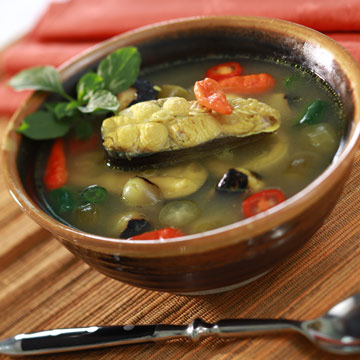
typical sweet and sour catfish Riau


catfish are attracted to fatty dishes berkuah. This time the feeling that we choose is a spicy sour. Pretty rich flavor that makes us extraordinary catfish.

MATERIALS:
1 kg of catfish, siangi, cut matching
10 pcs beans, siangi, cut matching
2 pcs carrots, siangi, cut matching
5 pcs star fruit wuluh
2 bay leaves
1 cm galangal, smashed
3 cm ginger, crushed
3 bay leaves orange
10 pcs full cayenne
1 tsp sugar
1 lt water
cooking oil

Seasoning mashed:
10 cloves shallots
5 cloves garlic
5 pcs red chili
5 btr pecans, toasted
2 cm turmeric, roasted
2 tsp salt

HOW TO MAKE:
# Fry until half cooked catfish. Set aside.
# Stir fry ground ingredients until fragrant, add bay leaves, galangal, ginger, lime leaves and chili sauce. Stir until wilted.
# Add water, sugar and star fruit wuluh. Let boil.
# Enter the chickpeas, carrots and catfish. Let it boil once again. Turn off the fire. Serve immediately.

TIPS & TRICKS:
# Catfish can be replaced with other fish, such as banding or catfish. Do not forget the first half-baked fries, yes, let the fish was not destroyed.

Tourism estuary Kuin floating market in Banjarmasin


Muara Kuin Floating Market is a traditional market which is above the Barito River at the mouth of the river Kuin, Banjarmasin, South Kalimantan. The merchants and buyers to use boats, boat name in Bahasa Banjar. This market
began after the dawn prayer until after 07:00 am. The sun rises reflect light between the transaction of vegetables and crops from the villages along the Barito river and its tributaries.
By witnessing a view, as if tourists were sightseeing. Jukung-laden boats with merchandise vegetables, fruits, all kinds of fish and other household needs is available in floating market. As the sun began to emerge the market gradually began to retreat, the merchants began to leave the floating market to bring the results obtained with satisfaction.

Floating market a unique atmosphere and distinctive are jostling between large and small boat buyers and sellers find each other are always milling about from place to place and always shaky play barito river waves. Floating market has no such organization in the market on the mainland, so it is not recorded how many traders and merchants bersarkan visitors or distribution of merchandise.

Boating women traders who sell their products themselves or their neighbors called the hamlet, while the second hand purchase from the hamlet for resale called panyambangan. Keistemewaan this market is still common among the traders barter transactions boating, which is in a language called Banjar bapanduk, something unique and rare.

Marlborough castle in Bengkulu

FORT Marlborough East India Company established under the leadership of Governor Joseph Callet. The fort is south facing and has an area of ​​44,100 square meters. Form XVIII century castle (1914) resembles a tortoise. Wide moat surrounded the main door and is connected by bridge to the gate inside. According to the local community, this castle has a door out underground.

Fort Marlborough is the biggest legacy of Indonesia's largest English. Marlborough Castle really is not just a military fortress, because it is built for the sake of trade; guarantee the smooth supply of pepper for the British trading companies, East India Company, and supervision of commercial shipping lane through the Sunda Strait. Fortress dual role: military defense headquarters as well as office and commercial center of British rule.

Bengkulu is the capital of the presidency (a collection of area residents) England on the west coast of Sumatra. Region was controlled from Fort Marlborough. Britain had also built forts and functions similar to a larger role in Madras, India, the Fort St. George. From this Madras, East India Company to develop the influence to the Asia Pacific region, including Bengkulu.

Fort Marlborough inhabited by civil servants and British soldiers. In a note the British Library, Oriental and India Office Collections in 1792 there were 90 civilian and military personnel live and work in Fort Marlborough. Officials or senior officers live in the castle with the family environment. This fortress-like dwelling in a small city with thick walls. Like life, the records concerning marriage, baptism, and death "resident" even this fortress can still be saved.

Marlborough Castle spatial design reflects the diversity of community activities. The complex of buildings is 44100.5 square meters, but the total buildings in the fort only about 20 percent. Part fort the rest function as open space. Castle Buildings Marlborough is very strong physically, among others, proved when an earthquake measuring 7.3 on the Richter scale devastated thousands of buildings and settlements Bengkulu earthquake of 2000 and to 7.9 on the Richter scale, the fort was no significant damage. In fact, the construction of the fort was not using reinforced concrete.

The basic design Fort Marlborough quadrangular. This design resembles a turtle, marked with four parts of the buildings angled like legs, and a group of buildings resembling the head of a turtle. The top of this building is connected to a circular courtyard cannon placements, as well as facilitate the mobility shift cannon. Another feature of this fortress are two layers of defense walls, so that when the front wall can be penetrated by the opponent, may soon withdraw troops and conduct the defense of the second wall.

The first phase of construction of the fort completed in 1718 with the main gate of the fort on the west side. Parts of the building resembles a turtle's head and then added in 1783. With this addition to the castle gate system layered defense. Robustness of the castle is reflected from the outer wall thickness of 8.65 meters and thickness as high as three meters. While the wall thickness of about 1.8 meters. Building materials such as rock, stone, and brick with an adhesive mixture of lime, sand, cement and red.

To enter the castle from the main gate, we must pass through two bridges that cross the dry gullies. Berkedalaman trench about 1.8 meters by 3.6 meters wide. Wooden bridges over the dry moat that originally was never to be appointed permanently to inhibit enemy movement. After the first gate, we're going down a short hallway with arched ceiling. Four large stone embedded on one side of these arches. The gravestones is a memorial of death a number of top brass castle, among others, Deputy Governor of England Richard Watts, died in 1705. Although the English-language memorial written in the old-fashioned letter, but most are still clearly readable.

Out of the entrance arches after this, we will down the road in the open space towards the second bridge. On the south side of the road was lined three tombs, one of which grave-Resident Thomas Parr was killed in December 1807. The existence of the cemetery showing the function of the fort to accommodate all the activities of residents from birth to death. Through the second bridge 3.25 meters altitude from the bottom of the ditch below him, arrived at the gate known as the great gate (main gate). Wooden doors on the second gate is still intact despite being nearly 300 years old. This leaves the door wearing lime wood species said to have originated from Kalimantan.

Three room we find on the left once through the great gate had functioned as the residence of the officers. These rooms in 1873 difngsikan as an armory. The first room resembles a 13.5-meter long tunnel with a width of about five meters. Inside there are three "kids room" measuring approximately 1.5 meters x 4.5 meters. This space seemed like a thick concrete closet. At the end of the hall there are doors leading to the basement down the fort buildings. Dark and humid in the spaces below give the impression penyusuran part of this castle smelled adventure. Space below mentioned function as a storage property.

On the other side of the entrance gate, we'll see a room with function is the main guard room or space that is not the castle guards on duty. On the inside, there are two military detention room. On one of the walls of the detention room was seen paintings and charcoal records in the ancient Dutch. Posts made by prisoners in the fortress estimated.

Along the south wing of Fort Marlborough there are rows of barracks room to sleep. Each room has one door facing the courtyard inside the castle. Though made of iron bars, doors are designed arches and pretty impressed. Curved design also looks at the ceiling. Office complex located in the north wing of the castle. Before the 1780s, the north side of this fort functioned into the family room and the senior civilian official residence single officer. While the warehouse and the governor's residence located on the west.

In his day, the castle is managed by a board consisting of the deputy governor as head of the occupied territories, the commander of the fort as a military leader, assisted by two officers. Other high officials is a kind of trade chief (senior merchant). In 1792, registered 18 trade attache office at Fort Marlborough. Some trade chief also serves as head of the territory or resident of the area along the western coast of Sumatra, among others, Manna, Lais, Christmas, Tapanuli, and Krui. In 1792 a clerk carrying nine people work and live in a castle. Technicians, health workers, the organist, until the carpenter had inhabited this castle.

In the middle of the fort, humble page in a grassy green with some shade trees. Pages in this large enough to function for a variety of military activity during that period, such as ceremonies and skill training. In this field also read the court's decision and the testimony of military execution. While the page shaded by trees with views of the high seas, a place to relax. The path connecting the main gate of the south with the north gate are in the middle of the page. North side of the gate is also connected by a wooden bridge outside the castle environment.

From the top wall of the fort or bastion, observed stretch of open sea. To raise the cannon in firing position on the bastion, built some of the incline of the order of bricks at the corners of this fort. In the bastion, we also can observe the channel showcase rooms such as chimneys. The mouth of the chimney was given the umbrella cone made of zinc so that air can circulate, but shielded from the outpouring of water. Exploring this castle would be complete without a down hallways underneath. Underground passageways are narrow and dark was the place where weapons storage. There is also an underground passageway connecting the fort with a way out without passing through the gates.

WEST LOMBOK Senggigi Beach


Senggigi Beach is a famous tourist spot in Lombok. Located on the west coast of Lombok Island. Senggigi Beach is not at Kuta Beach in Bali, but once we were here will feel like staying in Kuta Beach, Bali. Coastal beaches are still beautiful, although it is still littered with garbage foliage because rarely cleaned. Very beautiful underwater scenery, and tourists can do as much snorkeling as the waves are not too big. Coral reefs towering wave magnitude ketengah cause rupture in the middle. There are also hotels with prices ranging from expensive to economical hotel is worthwhile.

About half an hour by foot, the tourists can find Batu Bolong in this beach. This is a temple built on the reef which is located on the waterfront. According to local legend of yore often held sacrifice a virgin to fed to the sharks in this place. Another legend says early days, many women who deploy away from this place into the sea because of a broken heart. From this place also seen Mount Agung in Bali.

Not far from Batu Bolong contained the tomb of a scholar. This is a sacred place for the adherents of Wetu Telu.

Senggigi Beach, located on the north ward, is the most popular beaches and is famous for its beauty. The beach is located 12 kilometers northwest of Mataram, West Nusa Tenggara (NTB), Lombok, stretching nearly 10 km long with white sand that seemed to tempt you to sit on it and for a moment forget all your life routine, traffic density city , and breathe in fresh air to enjoy the scenery of sea water blue green shades and enjoy the beautiful sunset on the beach of Senggigi.

Getting There
There are several alternatives to achieve Senggigi Beach, namely:

* From Bali; Arrive in Sheet Harbour, you can go straight to Senggigi beach by bus 3 / 4 or chartered car with other passengers.

* From Jakarta and other big cities; Arrive at the airport, you can ride a taxi that will take to the hotel where you stay.

* From Ampenan, you can climb Bemo is available from 06.00 AM to 06.30 PM for about Rp. 1.500 majors Ampenan-Senggigi, or Senggigi-Ampenan

Where to Stay
In the vicinity of Senggigi Beach there are many lodging options that can be tailored to your needs. Starting from hotels, resorts, hotels jasmine to lodging. Some places to stay that can be used as an alternative is the Holiday Inn, the Oberoi, Sheraton Senggigi, Melati Dua Cottage, Pool Villa Club, Panorama Cottage, and others.

Dining Guide
Along the beach, lined up restaurants that provide various types of Lombok's cuisine and other dishes. During his stay in Lombok, do not forget to taste the Chicken Taliwang and Plecing Kangkung.
Tour
If you want around Senggigi beach, but do not want to get tired, you can climb Cidomo "NTB typical freight pulled by a horse. Or you can also walk around the beach with

Things to See or Do
Many of the activities you can do here, such as swimming, canoeing, diving, snorkeling or just sunbathing and enjoying the scenery.

Souvenir
Along the Senggigi beach, there are many souvenir shops that offer unique goods Lombok handicrafts such as paintings, handicrafts, woven cloth Lombok, pearl jewelry and others.

Tips
* Do not forget to bring sun block and extra clothes.
* Do not forget to bring a bathing suit.
* When you are swimming, please be careful because there are many coastal rocks.

Sunday, May 29, 2011

Why Use PASCAL ?

Why use Pascal

“A low level language is one whose programs require attention to the irrelevant.”
[edit]
Introduction

Pascal often comes under attack as a language which should be dead, or as a language not suitable for very much.

This document will discuss these claims and add latest informations about pascal as of 2005 and beyond.

What is Pascal ?

Pascal is a very clean programming language, which looks more like real languages in the sense that it uses real English words as keywords rather than random ASCII characters. This is important in understanding existing code as well as debugging because people don't read individual characters but whole words.

A common misconception is that Pascal started as a teaching language. While this is partially true, the associations are usually wrong; usually that makes people expect systems like Logo, limited playing grounds for children.

Pascal, like its predecessor ALGOL(-60), however was primarily designed as a language for formal specification and teaching of algorithms, mostly with future engineers and computer scientists as target. Contrary to ALGOL-68, an accent was put on simplicity. This turned out to be beneficial for compiler construction.

The initial Pascal dialects had a series of serious ugliness (like untyped procedure variables) that were quickly remedied, way before the language's prime time in the eighties. (revised J&W and early standardization trajectory)

Further modernization and facilities for interfacing to lower level systems were added to nearly every dialect. These weren't standarized back into the language mostly, but this was normal at the time (way before C and POSIX standards). However the dialects were not entirely random, and could be classified into two major streams, UCSD/Borland like and ISO standards compliant, with Apple creating a hybrid between the two (UCSD in origin, but incorporating most level 1 ISO features)

Over the years specially the Borland stream language has matured and gained all capabilities necessary for up-to-date large scale software projects (for example the Free Pascal compiler or the Lazarus IDE).

The particular strength of Pascal is that most of the developing time is spent on the program itself, contrary to C and C++ like language, where the developer needs to focus on managing the memory of variables or the structure of very basic things like passing parameters and returning them back again.

As a result, Pascal developers do not have to learn a new sub-language inside the same language, like C++, STL, MFC.
[edit]
The Readln and Writeln effect

Most developers, who ever touched Pascal, did not like the language, because they only learned some very basic commands and how to write a more structured code than their mind was thinking at the time.

That is, why languages such as C and Perl, for example, have tended to win the popularity contests. While Pascal seems very basic and very minimalistic, when you uncover the true language, you find that it is much easier to create a program in Pascal than in C, Java and other popular languages. Even languages such as Python, that is popular and still remains structured, have many elements of a disoriented language. That issue arrives first of all from the attempt to create the most “perfect” programming language, that will be easy to use, and have the cleanest way to create things.

Google Adsense, How to USE it

How to Use Google Adsense


Google Adsense is an affiliate pay per click program that has taken the Internet by storm. There are a plethora of sites dedicated solely to Google Adsense. Google Adsense is a good way for a small Internet site owner to make some extra money. Using Adsense does not require any special knowledge, just a computer and a working web site.

Difficulty: Moderate

Instructions

1

Construct a web site for use with Google Adsense. Google has a published criteria for the web sites they accept to the Adsense program. A good rule of thumb is just construct an honest and forthright web site that has legitimate purpose other than attaining revenue from the Google Adsense program.
2

Sign up for the Google Adsense Program having the following information available during sign up: website URL, website language, name, address and telephone number.
3

Submit the sign up information. Once all the steps at Google are complete and the policies are read, click the "Submit" button.
4

Activate the Google Adsense account. Upon account approval, an email notification will arrive. Click on the link in the email to activate the Adsense account.
5

Log in to the adsense account and obtain the HTML code for the approved site. Type in the username and password in the adsense log in box. Next click on the "Adsense setup" tab. Click on the "Adsense for content" link. Choose the "Ad unit" option in the next screen and select "Continue." And finally select the correct "Ad format" and then choose "Continue."
6

Copy and paste the generated ad code into the appropriate section of the web site. In the grey Google adsense box there is HTML code to copy into the user web site. Copy that code and place in the appropriate place in the web site.

By an eHow Contributor